From One Biodigester to Thousands: What It Takes to Scale a Climate Project
A single biodigester can turn organic waste into useful biogas. Thousands of biodigesters can create something much bigger: a network of climate infrastructure capable of supporting cleaner cooking, better waste management, local employment and measurable emission reductions.
But there is a major difference between proving that one biodigester works and deploying them at scale. For crbcoin, that difference is where much of the real work begins.
The Basic Technology Is Surprisingly Simple
A biodigester uses a natural process called anaerobic digestion. Organic material such as animal manure and agricultural waste is placed inside a sealed system. Without oxygen, microorganisms break down that material and produce biogas containing methane.
Instead of allowing that methane to escape uncontrolled, the gas can be captured and used as an energy source. For households, one potential application is cooking. The process can also leave digestate that may have agricultural uses depending on the system and local conditions.
One Installation Is a Technology. Thousands Become Infrastructure.
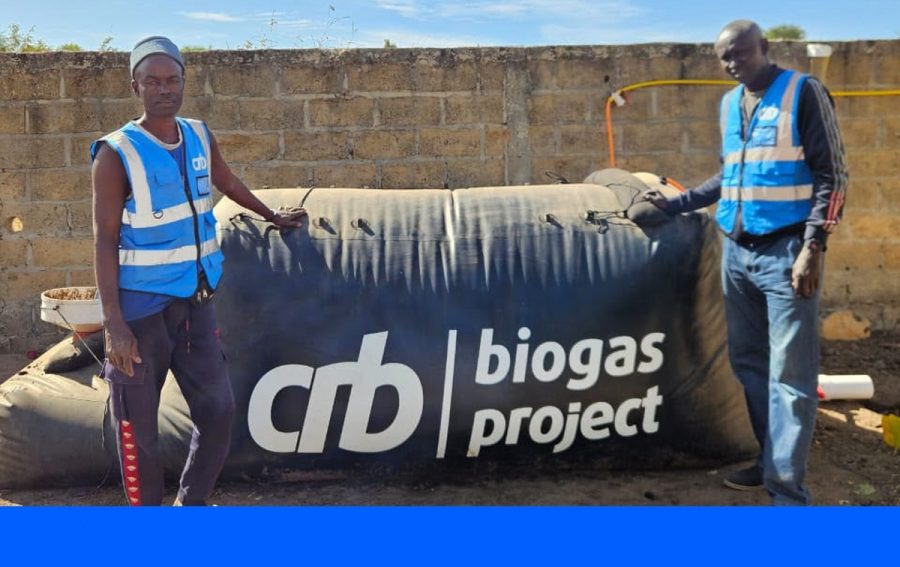
Installing one biodigester means supplying one system, preparing a suitable location and teaching users how it works. Multiply that process by hundreds or thousands and the challenge changes.
Manufacturers need production capacity. Materials need consistent specifications. Systems have to be transported and distributed. Installation teams need training, households need support, maintenance has to be organized and project data has to be collected.
If emission reductions are intended to generate carbon credits, the relevant monitoring and verification requirements also need to be incorporated into the programme.
From Manufacturing to Senegal
crbcoin’s project model connects manufacturing and supply with implementation in Africa. Senegal is one of the countries where crbcoin and related project activities are developing real-world climate infrastructure, and biodigesters form part of that wider focus.
The journey does not end when equipment leaves a factory. Systems have to arrive in-country, reach project locations, be installed correctly and continue to operate. Local teams need to understand the technology and users need to know how the system should be used.
Local Jobs Are Part of Scaling
Climate infrastructure does not install itself. Larger deployment can require local coordinators, installers, technicians, logistics personnel, trainers, monitoring teams and administrative support.
As deployment increases, so can the need for local skills and employment. When structured effectively, projects can build technical knowledge, create economic activity and establish local teams capable of supporting infrastructure over the long term.
One biodigester can serve one location. A programme involving many installations can require an entire local ecosystem around it.
Carbon Credits Require More Than Installation
A physical biodigester is not automatically an issued carbon credit. Recognized carbon standards use methodologies that determine eligibility and how emission reductions are calculated and monitored.
The biodigester creates the physical activity. The methodology provides a framework for quantifying eligible climate impact. Monitoring provides the data, while the applicable validation, verification and issuance process determines whether eligible reductions can ultimately become carbon credits.
Why Monitoring Matters
Installing large numbers of biodigesters means little if nobody knows which systems continue to operate. Monitoring can help identify problems, improve maintenance and strengthen project data.
This supports a wider principle behind crbcoin: real-world impact should increasingly be visible and measurable. crbcoin has already applied that philosophy to other infrastructure, including a rural borehole project in Senegal where a live camera was introduced so activity could be seen at the project location.
Building Before Scaling
Water purification, clean cookstoves and biodigesters are different technologies, but scaling them creates similar operational questions: who manufactures the product, how does it reach Africa, who installs and maintains it, how is impact measured and how can the project create opportunities locally?
Those questions are why factories, suppliers, local teams, training, monitoring and due diligence are not separate stories. They are pieces of the same system.
A biodigester starts with something ordinary: organic waste. Turning that technology into a functioning programme requires an ecosystem around it. For crbcoin, the ambition is to build the structure capable of taking real-world climate solutions from production to deployment — and eventually to scale.
Scaling carefully is therefore more important than simply scaling quickly. Production quality, training, maintenance and reliable monitoring all need to grow alongside the number of installations if a project is to create durable value.
INTERNAL SOURCE NOTE – DO NOT PUBLISH: Gold Standard AWMS v2.0 (2026) covers biogas systems recovering methane from animal manure and organic waste for thermal energy use; project eligibility and credit issuance remain methodology- and verification-dependent.