What difference can less than $20 really make?
For many of us, $20 is an everyday amount. It might pay for lunch, a taxi ride or a few cups of coffee. But for a family living in poverty in Africa, an investment of less than $20 in a simple water purifier can potentially make a meaningful difference to everyday life. It can provide easier access to cleaner drinking water, reduce the need to boil water over a fire and, at the same time, help reduce the greenhouse-gas emissions associated with burning fuel.
For Hilde Watty, this is exactly where the story behind the projects connected to Crbcoin (CRB) begins: not with carbon credits or technology, but with people.
A Personal Connection With Africa
Through her many journeys across Africa, Hilde has experienced both the extraordinary beauty of the continent and the difficult circumstances in which many families still live. Those experiences have made a lasting emotional impression on her and have shaped what she wants to achieve through the projects she supports.
Her focus is particularly close to three areas: helping families living in poverty, supporting and empowering women and girls, and giving children better opportunities for the future.
These are enormous challenges, and no single project can solve them. But sometimes meaningful change can start with something surprisingly small.
A water purifier is a perfect example.
The Story of One Family
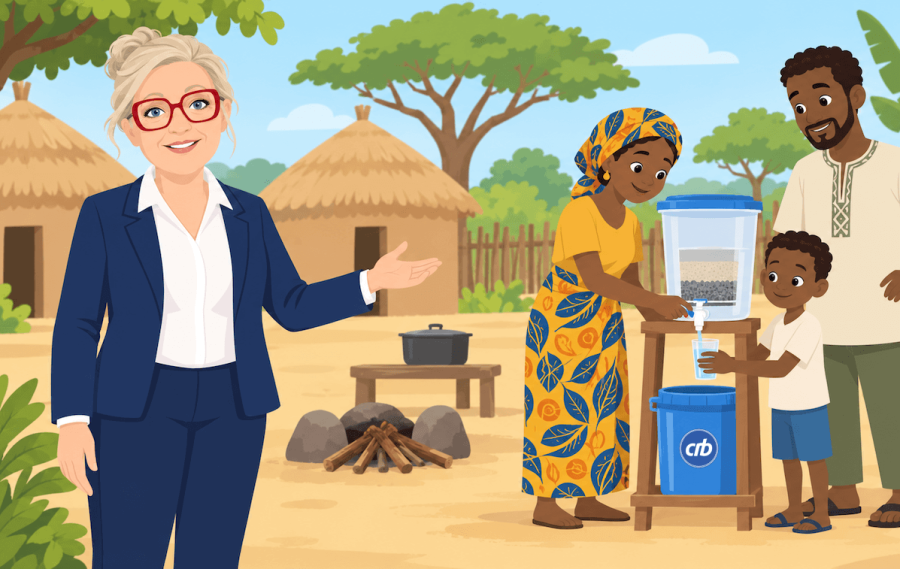
Imagine a family living in a rural African community without reliable access to safe drinking water. Their water may come from a river, lake, well or another local source. To make that water safer to drink, the family may traditionally need to boil it.
That sounds simple, but boiling water every day requires fuel. In communities without reliable electricity or gas, families can depend on firewood or other traditional fuels. Someone has to collect or purchase that fuel, transport it home and prepare the fire.
These daily responsibilities can particularly affect women and girls. Time spent collecting water or firewood is time that cannot be spent working, caring for a family or attending school.
Now imagine placing a simple water purifier in that household for a cost of less than $20. The family can potentially treat its drinking water without having to boil the same amount of water every day. That can mean less firewood, lower household fuel consumption, less smoke and easier access to cleaner drinking water.
For a family living on a very limited income, those changes can matter far more than the modest price of the purifier suggests.
Clean Water Can Also Mean Climate Action
The connection between water purification and climate change is not immediately obvious, but it is important.
When households burn wood or other fuels to boil drinking water, greenhouse gases are released. If an effective water purifier reduces the need for boiling, it can also reduce the amount of fuel consumed and therefore the emissions associated with that fuel use.
The climate impact of one household may be relatively small. But carbon projects are built around scale.
If 100,000 families can reduce their dependence on boiling water, thousands of individual changes can collectively result in substantial avoided fuel consumption and potentially significant carbon-emission reductions. In areas where firewood is widely used, reducing demand can also help decrease pressure on local forest resources.
This is why certain clean-water projects in Africa can potentially qualify as carbon projects under recognised carbon-credit methodologies.
Importantly, distributing a water purifier does not automatically create a carbon credit. The project must establish the appropriate baseline, document distribution, monitor actual usage and calculate eligible emission reductions according to the applicable methodology. Those results then need to undergo the relevant independent verification and certification process.
Only verified reductions can ultimately form the basis for the issuance of carbon credits.
Why Women and Girls Matter in This Story
For Hilde, the environmental impact is only part of the story. Her experiences travelling through Africa have given her a particular interest in improving opportunities for women and girls.
In many families, women carry a large share of the responsibility for obtaining water, finding fuel, preparing food and looking after children. Girls can become involved in these responsibilities from a young age.
A water purifier will not solve inequality by itself. But when technology reduces one repetitive household burden, the time saved can potentially be used elsewhere. For a mother, that might mean more time for her family or earning an income. For a girl, it could mean more time for education.
That is why clean-water initiatives can be much more than environmental projects. They can form part of a broader effort around poverty reduction, women’s empowerment, children’s health and access to education.
From One Purifier to 100,000 Families
The power of the concept becomes clearer when we return to that first purifier.
One device costing less than $20 can help one household. Now imagine distributing water purifiers to 1,000 families, then 10,000, and eventually 100,000 or more.
At that point, the project is no longer simply about supplying equipment. It is potentially improving access to cleaner drinking water for hundreds of thousands of people while reducing the amount of fuel used to boil water across entire communities.
That creates an unusual combination of humanitarian and environmental impact. The same project can support families living in poverty, reduce burdens that often fall on women and girls, improve circumstances for children and contribute to reducing greenhouse-gas emissions.
It is a practical example of how sustainable development and climate action can reinforce each other rather than being treated as separate goals.
The Human Impact Behind Crbcoin (CRB)
Carbon markets can appear abstract. Discussions quickly move towards tonnes of CO₂, methodologies, verification, registries and carbon-credit prices. But behind every credible carbon project, something first has to happen in the real world.
In a clean-water project, that real-world impact can begin when a family receives a purifier.
The physical project comes first. Distribution and monitoring follow. The environmental impact must then be measured and independently verified before eligible emission reductions can become certified carbon credits.
This connection between real-world climate projects, measurable carbon reduction and digital technology is central to the vision behind Crbcoin (CRB).
For Hilde, however, the starting point remains human. Her ambition is to support families who need help, stand up for women and girls and give children better opportunities. If those same projects can simultaneously reduce carbon emissions and contribute to the fight against climate change, their impact becomes even greater.
Sometimes a Big Difference Starts With Less Than $20
Climate change is often discussed in terms of billion-dollar investments, enormous renewable-energy projects and international agreements. All of those have an important role to play.
But climate action can also begin at household level.
A water purifier costing less than $20 may look insignificant in the context of the global climate challenge. For the family receiving it, however, it can be very significant. And when that same intervention is repeated across tens or hundreds of thousands of families, small individual changes can become measurable impact at scale.
That is what makes these projects powerful: cleaner water for families, greater opportunities for women and children, reduced fuel consumption and a contribution to fighting climate change.
Sometimes, making a difference does not start with something enormous. Sometimes it starts with one family, one water purifier and an investment of less than $20.